Commonwealth Fusion Systems Installs First SPARC Magnets Ahead of 2026 Plasma Target
Commonwealth Fusion Systems has installed the first toroidal field magnets on its SPARC reactor in Massachusetts, advancing toward first plasma by late 2026.
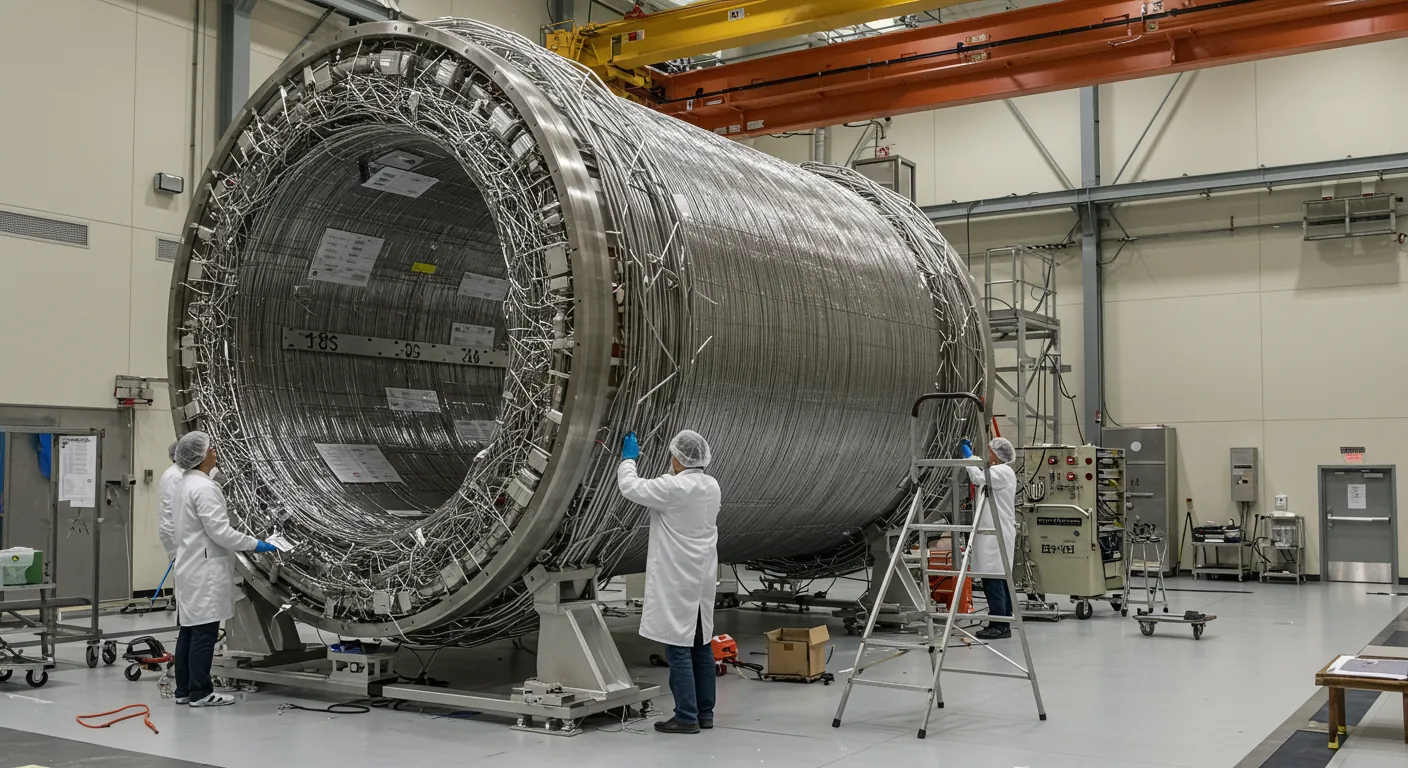
Commonwealth Fusion Systems has begun installing the massive superconducting magnets that will confine plasma inside SPARC, the company's demonstration fusion reactor in Devens, Massachusetts. The first of 18 toroidal field magnets is now in place, marking a critical step toward the facility's planned first plasma later this year.
The milestone puts CFS ahead of most private fusion competitors in the race to prove that a compact tokamak can produce more energy than it consumes. SPARC is designed to achieve a fusion gain of roughly Q=11, generating 50 to 100 megawatts of fusion power from just 25 megawatts of input heating.
Background
CFS spun out of the Massachusetts Institute of Technology in 2018 with a core bet: high-temperature superconducting magnets could shrink a fusion reactor from the scale of a cathedral to something closer to a factory floor. In September 2021, the company validated that bet by producing a 20-Tesla magnetic field, a world record for a magnet of its type, using roughly 165 miles of HTS tape.
The approach stands in sharp contrast to ITER, the multinational government project in southern France that has consumed more than $20 billion and decades of construction time. SPARC measures 3.7 meters in diameter, about one-quarter of ITER's size, yet aims for comparable plasma performance.
CFS has raised nearly $3 billion in total capital, accounting for roughly one-third of all private fusion investment worldwide. Backers include Breakthrough Energy Ventures, Google, NVIDIA, and investors tied to Jeff Bezos. The U.S. Department of Energy has also selected the company for a $46 million milestone-based award under a $415 million federal fusion program.
Key Details
The toroidal field magnets are the structural backbone of SPARC. Each one weighs several tons and must maintain its superconducting state at cryogenic temperatures while containing plasma heated to more than 100 million degrees Celsius. Workers had previously lowered a 48-ton vacuum vessel half into position before the magnet installation could proceed.
Bob Mumgaard, co-founder and CEO of CFS, has been explicit about commercial intent. "If you only build one fusion power plant, we have utterly failed," Mumgaard said in recent remarks. "You need thousands. Reaching this milestone shows you have got a useful product, not just a project."
The company's six-step milestone framework places the current work between Milestone 3 (machine assembly) and Milestone 4 (Q-Plasma greater than 1). Full deuterium-tritium operations are expected in 2027, when CFS aims to demonstrate net energy gain from the plasma itself.
U.S. Energy Secretary Chris Wright visited the Devens facility earlier this year, underscoring federal interest in private fusion as a potential source of carbon-free baseload power.
Impact
If SPARC performs as designed, it will be the first fusion device built by a private company to produce net energy from plasma. That distinction matters because it would validate the commercial viability of compact, high-field tokamaks as a category, not just a single machine.
The downstream consequences are already taking shape. CFS has selected Chesterfield County, Virginia, as the site for ARC, its first commercial power plant. ARC is designed to produce 400 megawatts of electricity, enough to power approximately 150,000 homes. Dominion Energy Virginia is the commercial partner for grid integration at the James River Industrial Park location.
Skeptics note important caveats. Professor Hartmut Zohm of the Max Planck Institute has expressed cautious optimism about SPARC's physics but warned that ARC faces far greater engineering challenges, particularly around neutron damage to reactor components and tritium breeding. Others in the field argue that industry figures around Q-Plasma can mislead the public, since a reactor might achieve plasma ignition while the overall facility still consumes more energy than it delivers.
The distinction between Q-Plasma and Q-Total remains central to honest accounting. A machine that heats plasma efficiently but requires enormous cooling and auxiliary systems may never produce economical electricity. CFS acknowledges this gap and has framed Q-Total, the point where the entire plant produces more energy than it uses, as its ultimate commercial benchmark.
What's Next
CFS plans to complete installation of all 18 toroidal field magnets by mid-2026. First plasma, the moment when hydrogen gas is ionized inside the machine for the first time, is targeted for late this year.
Full-power deuterium-tritium experiments, the kind that would demonstrate actual fusion gain, are scheduled for 2027. Construction on the ARC commercial plant in Virginia is expected to begin in 2027 or 2028, with grid delivery targeted for the early 2030s.
The company is also working with Google DeepMind and NVIDIA to build digital twin simulations of SPARC. These AI models are intended to optimize real-time plasma control, a task that requires adjusting magnetic fields thousands of times per second in response to turbulent plasma behavior.
Whether SPARC delivers on its physics promise will determine not just the future of CFS but the credibility of private fusion as an industry. Dozens of startups have raised billions on the premise that fusion energy is finally within reach. SPARC's first plasma will be the first major test of that claim.
Tags
Related Articles
IceCube Search for Extremely High-Energy Neutrinos Narrows Cosmic Ray Mystery
Using 12.6 years of data, IceCube set the tightest limit yet on neutrinos above 10 PeV and used it to constrain the proton fraction in ultra-high-energy cosmic rays for the first time.

Hydrogen From Bioethanol at 270°C With Zero Direct CO2 Emissions
A new catalyst turns ethanol into hydrogen and acetic acid at 270°C with no direct CO2 release. The process can meet U.S. green hydrogen rules and has been run 100+ hours continuously.
Obelisks: New RNA Entities in Human Microbiomes Challenge Definition of Life
Scientists have found obelisks—viroid-like RNA elements—in bacteria across seven continents. They appear in half of oral samples and force a rethink of what counts as alive.